

The 5C+1 Framework names five non-hierarchical functions that every city movement core team needs — and one external role that keeps the team strong without adding another layer of authority. It is not an org chart. It is a shared vocabulary for contribution.
I developed this framework during the Love Hanoi transition from a founder-led community ministry to a local core team-led city movement network. It synthesises concepts from David Ehrlichman’s Impact Networks with practitioner insights from a spokesman for Mumbai Transformation Network. I first applied it as a working language for the Love Hanoi Core Team and offer it here as a transferable tool for city movement networks in any context.
Why role language matters
The problem the 5C+1 Framework addresses is not a shortage of people. Most city movement teams have willing participants. The shortage is clarity — shared language for what different people actually do, how their contributions fit together, and what the team is missing.
Without that language, city movement teams reach for familiar words — leader, coordinator, facilitator — and those words carry weight they were never meant to carry. “Leader” implies hierarchy. “Coordinator” can mean anything from keeper-of-the-calendar to director-of-everything. “Facilitator” can describe someone who designs meaningful spaces or someone who merely runs a meeting. When teams use these words loosely, the same two or three people quietly absorb everything the language does not name, and the team’s gaps become invisible.
I encountered this problem directly. In 2025, Love Hanoi was transitioning from a community service initiative — built around a founding leader and a clear event-driven model — to a citywide network of connection and influence led by a local core team. Twelve pioneers stepped forward to build that team. The question was not whether they were committed. It was how to help them see what the team needed, where they were strong, and what was thin.
“Love Hanoi is a city movement network. It’s not an organisation. It’s not a business. It’s not a church. It’s not an NGO. So you have to put aside all your previous concepts.”
That clarity is harder than it sounds. Every team member brought a different mental model from their previous context — pastoral, nonprofit, business, medical. Each model carries assumptions about how leadership works, who decides, and what counts as real contribution. The 5C+1 Framework gave the team a shared vocabulary that belonged to none of those previous worlds: city movement language, built for a city movement team.
Where the framework came from
The framework emerged from two sources: a book and a conversation. Together they gave me both a structural vocabulary and a practitioner reality check.
The book: Impact Networks
The Love Hanoi Core Team was reading David Ehrlichman’s Impact Networks chapter by chapter — a book that defines impact networks as webs of relationships that bring people and organisations together for learning and coordinated action around shared purpose. Ehrlichman identifies five core activities that sustain any impact network: clarify purpose and principles, convene the people, cultivate trust, coordinate actions, and collaborate for systems change. He also names four network leadership roles: catalysing, weaving, facilitation, and coordination.
These gave me my initial structure. The five core activities were already C-words. The four roles mapped naturally to four of the five Cs: Catalyst (catalysing), Connector (weaving), Convener (facilitation), Coordinator (coordination). The fifth core activity — collaborate for systems change — was not a single role but the shared work of the team at full strength. A fifth C-role was still missing.
The conversation: Mumbai Transformation Network
I sat down with a spokesman for Mumbai Transformation Network after his presentation at a YWAM consultation in Mumbai. He was one of the movement’s founding pastors — born from a 2003 prayer summit where the pastors of Mumbai repented of the sin of divisiveness. Over more than two decades he helped build MTN from a small gathering of pastors into a movement sharing its model with over twenty Indian cities. Through the COVID period MTN went through a significant reframing: a deliberate handover to a younger, more intergenerational and multi-sectoral team, with him stepping back from operations into a senior mentor-coach role. By the time I met him, he was himself living out the Coach/+1 distinction he was about to describe to me.
What I heard in that conversation shaped the framework decisively. He opened with a framing that set the tone for everything that followed: “We believe in scaffolding, not a structure. So you’ve got to have roles that are not hierarchical.” The word scaffolding is precise. Scaffolding supports the building while it goes up. It is not the building. It can be adjusted, extended, removed. It does not become a permanent feature of what it helps create.
“We believe in scaffolding, not a structure. So you’ve got to have roles that are not hierarchical.” — a Mumbai Transformation Network spokesman
He described several non-hierarchical functions his movement had identified over twenty years of practice: the Mentor-Coach, the Developer, the Codifier, and what he called a catalytic person — someone who consciously cultivates cross-denominational relationships through coffees and lunches, because that kind of trust-building “normally happens within a denomination” and “doesn’t have cross-denomination.”
Two of those insights became the fifth C-role and the +1. His description of Developer and Codifier gave me the missing function: the person whose job is to turn what the movement is learning into something others can start from. And his description of Mentor-Coach gave me the +1: a role so important it deserved its own place in the framework, but distinct enough from core team membership that it needed to be held separately.
The framework
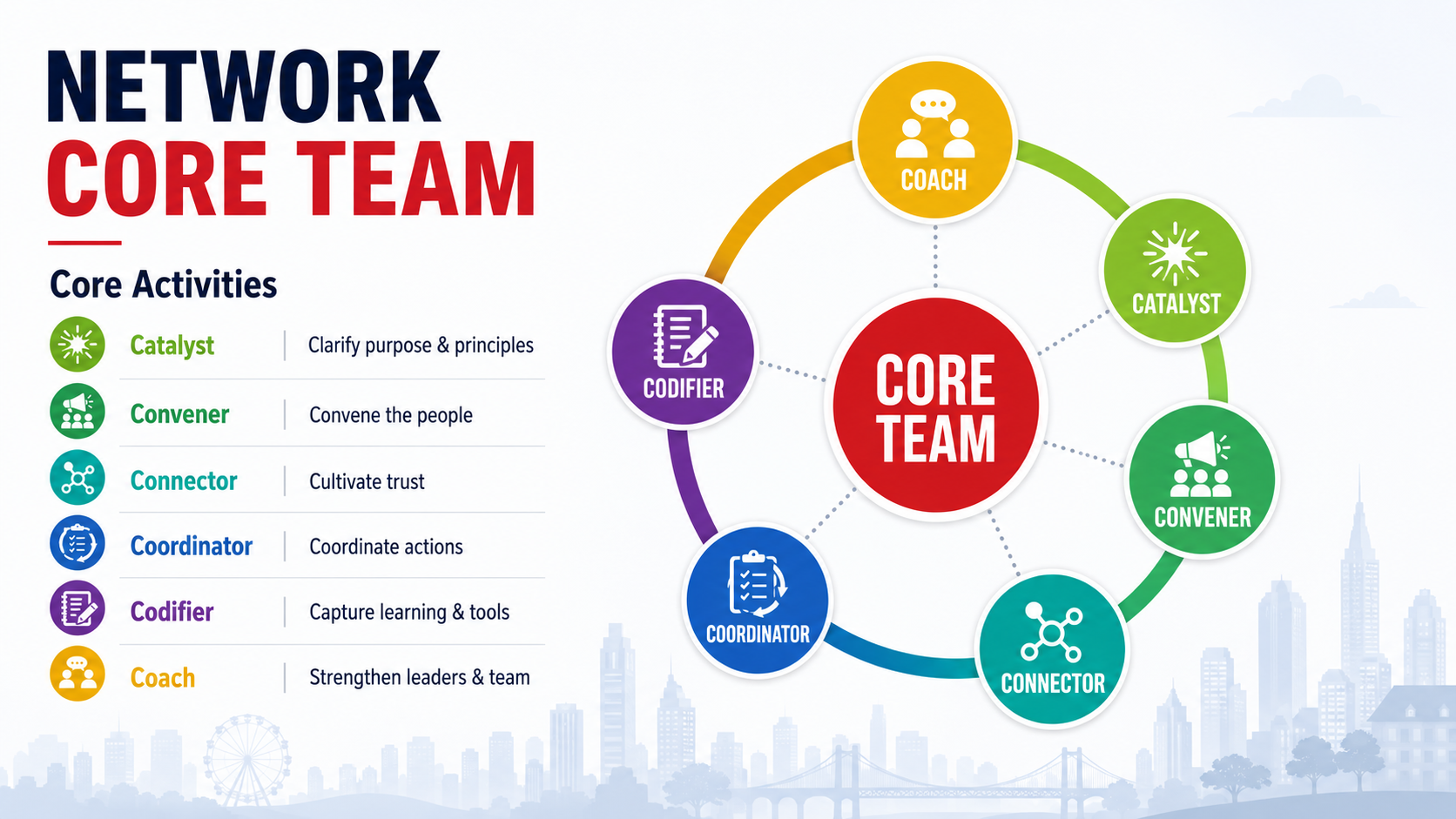
Five functions form the core team. A sixth role — Coach — supports the team from outside. The roles are functions, not ranks. One person may hold more than one. What matters is that all five functions are covered.
Catalyst
Spark momentum — move vision from idea to action.The Catalyst notices what is ripe, names the next win, and refuses to let the movement stay stuck in discussion. In a city movement context, that looks like discerning where a new issue network is ready to form, activating the right people for a first gathering, turning a shared prayer burden into a concrete pilot, or removing the blocker that has been quietly stalling momentum for three months. The Catalyst is not the person who does everything. The Catalyst is the person who gets things started.
He named this function in passing, describing the kind of person a city movement needs to cultivate relationships across denominational lines: “There must be a catalytic person who does that.” In Impact Networks, Ehrlichman describes catalysing as the role that brings people together to explore and launch a new network. I held both together: the Catalyst sparks momentum at the city level and helps new issue networks get off the ground.
When Catalyst function is absent, the movement becomes a fellowship of shared concern rather than a movement of shared action. People pray, agree, and express hope — but no one initiates. Opportunities pass. Potential partners wait for someone else to make the first move. The guardrail: Catalyst must not become the hero, the pressure machine, or the owner of everyone else’s obedience. Catalyst ignites but does not control.
Connector
Strengthen trust across streams, churches, and sectors.The Connector is the relational engine of the movement — the person who notices who is isolated, which churches do not trust each other, which organisations are overlapping without collaborating, and which leaders should know one another. The Connector makes introductions. The Connector repairs drift before it becomes fracture. The Connector does not only connect people who already like each other — the Connector bridges across difference, across denominations, across sectors, across generations.
He was direct about how this works in practice: the coffees and lunches that build cross-denominational trust “normally happen within a denomination” — inside an existing network of like-minded people. The Connector takes that practice and applies it cross-stream, intentionally and persistently. In Impact Networks, Ehrlichman calls this role Weaving: nurturing connection to foster new relationships across the whole system. I kept the C-word Connector while retaining Weaver as explanatory language.
When Connector function is absent, the network fragments. Churches stay in their denominational lanes. Issue networks become silos. Misunderstandings harden because no one tends the relational fabric. Collaboration slows because trust is too thin for risk. The guardrail: Connector must not become a gatekeeper, a gossip channel, or a relational bottleneck. Connector opens doors — does not control access to the movement.
Convener
Create spaces where the right people gather to pray, align, decide, and act.The Convener designs the gathering, not just the agenda. They think about who needs to be in the room, what kind of space will let people speak honestly, what decisions need to be made, and how to close with clear owners and next steps. The Convener hosts courageous conversations, facilitates alignment, and creates the conditions for the whole to act as a whole rather than as a collection of individual interests.
This is the role he described when I asked him what Mumbai Transformation Network calls the key facilitating person. The answer was unambiguous: “We never use the word leader.” What they use instead — Facilitator, Lead Facilitator — names the same function as Convener: not a platform personality or a charismatic authority figure, but someone who serves the group by creating space where the group can function well. The skill is not commanding the room. The skill is making the room work.
When Convener function is absent, meetings become vague, crowded, or dominated by whoever speaks most. Gatherings happen but alignment does not. Quiet leaders and local voices are consistently missed. The movement may have strong relationships and clear purpose, but it cannot convert them into shared decisions and shared action. The guardrail: Convener must not become a controller, a stage performer, or a meeting addict. More gatherings are not the goal. Fruitful space is.
Coordinator
Create reliable rhythm so follow-through does not fall apart.The Coordinator makes the movement reliable. They manage the calendars, the reminders, the action trackers, the decision logs, the communication updates, the handoffs between people. They help the whole system remember what was agreed, who owns it, and what happens next. In a team of busy pastors, business leaders, nonprofit directors, and professionals — all giving part of their time to the city movement — the Coordinator makes it possible for the rest of the team to contribute without carrying the operational weight of the whole.
In Impact Networks, Ehrlichman describes coordination as providing operational support to sustain network activities and accelerating the flow of information and resources so people can act. He also notes that Coordinator is often the function best suited to a paid staff position — the person whose operational backbone work is too important and too time-consuming to depend entirely on volunteer energy. I applied this directly: the Love Hanoi executive team structure places the staff Coordinator at the centre of between-meeting decision-making, alongside a term-based Lead C person and Vice Lead C person. The Coordinator is not the boss of the team. The Coordinator is the operational backbone — the person without whom everything agreed in the room tends to evaporate before it becomes action.
When Coordinator function is absent, the movement is relationally warm and visionally clear but operationally unreliable. Volunteers do not receive information. Commitments do not become follow-through. Leaders lose confidence — not in the vision but in the team’s capacity to execute. The guardrail: Coordinator must not become a bureaucrat or a bottleneck. Coordination serves flow. It must stay lightweight, practical, and self-organising in spirit.
Codifier
Turn lived experience into simple tools that allow the movement to multiply.The Codifier is the role I was missing until this conversation. He described how Mumbai Transformation Network writes everything down: “We codify everything that we put down. So the last eight years have been massively codified. It’s all done. If you do a new idea, you codify it.” The point is not bureaucracy. The point is that learning which stays in someone’s head cannot travel. A movement that cannot capture what it is learning is a movement that requires everyone to rediscover everything.
He also described a related role — the Developer — and the image he used for it is precise. “A classical idea of a developer would be Matthew, Mark, Luke and John. They record it — but not as secretaries. They record it as envisioners.” The Codifier is not a minute-taker. The Codifier is an envisioner who captures meaning, story, and transferable learning. I integrated Developer into Codifier to make the fifth C-role: the person who turns practice into language, language into tools, and tools into something others can start from.
“When you read the Gospels, you don’t feel you’re being straightjacketed. You find life in it.” — one of MTN’s mentors, on what codification should feel like
The guiding principle he offered for codification is “codify, then contextualise.” A good codified document creates a baseline conversation — a starting point that any city can take, read, and adapt to their own setting. It does not prescribe. It invites. When Codifier function is absent, learning evaporates. New ideas stay in someone’s head. Each new leader has to rediscover what the previous generation already worked out. The movement becomes personality-dependent, because the wisdom has never been transferred into shared language. The guardrail: Codifier must not become rigid, academic, or controlling. Codification creates clarity, not compliance. The moment it becomes a straightjacket, it has failed its purpose.
The Coach — and why the +1 matters
Coach is the +1: not an internal core team function but a strengthening relationship around the team. Coaches advise, mentor, challenge, encourage, and help the team interpret the season it is in — without becoming part of the decision-making structure. They are not the sixth C. They are the people who help the five Cs function at their best.
My framing is deliberately broad: I separate Coach as non-team members — founder or senior mentors, professional coaches, peer leaders from other movement networks, experts in a related field, or even a donor with genuine strategic insight. A Coach can be a founder who carries movement memory and spiritual authority but is no longer driving the day-to-day. A Coach can be a peer leader from another city movement network who has navigated similar transitions. A Coach can be a subject-matter expert in disability, creation care, business, or inner healing. A Coach can even be a donor — if their understanding of the movement runs deeper than their financial contribution.
He described this function when he named Mentor-Coach as the first non-hierarchical role a city movement needs: someone who strengthens people and keeps relationships easy, without claiming authority over those they serve. His own experience of being changed “from a dominant leader into an influence-based leader” — a shift that came through crisis and pain at age 54 — shapes how he understands this role. The Coach is not above the team. The Coach is beside it.
“The accountability must be voluntary accountability. The moment it gets into positional accountability, you’re asking for trouble.” — a Mumbai Transformation Network spokesman
The Coach role also protects the team from founder-dependency. When a Coach is clearly external — not inside the operational core — their presence strengthens without creating a hidden hierarchy. If a founding leader continues as a Coach rather than a Core Team member, the team knows they are leading. The founder knows they are serving. The distinction matters more than it may first appear.
Primary and Secondary C
Every core team member identifies their Primary C — the function that feels most natural and fruitful — and their Secondary C, the function they can carry or support when needed. This matters because city movement teams, especially in early stages, cannot afford role purity. One person will often hold more than one function. The Primary/Secondary framework makes that visible and manageable rather than invisible and exhausting.
One clarification I want to emphasise: all core team members can catalyse impact networks, regardless of whether Catalyst is their Primary C. Catalysing an issue network is an action any team member can take. It is not proof that a person is the team’s Catalyst. The Catalyst as a primary function is about someone whose most natural contribution is sparking momentum across the whole movement — not the only person allowed to start something.
Primary and Secondary C works best with community confirmation. Self-assessment is a starting point; peer input closes the gap. People sometimes underestimate themselves. Others choose roles they admire rather than roles they actually practise well. Asking trusted team members and close outside voices to affirm or challenge a person’s reading of their own strengths is part of the process.
The practical value is diagnostic. If a team has several Catalysts and no Coordinator, momentum will be high and follow-through will be poor. If Codifier is absent, learning will be rich and invisible. Naming Primary and Secondary C across the team allows deliberate recruiting for the gaps — and allows the executive team’s lead role to rotate toward whoever the movement needs most in its current season.
Issue-focused impact networks
The 5C+1 Framework applies not only to the city movement core team but to every issue-focused impact network that grows within it — creation care, disability, education, evangelism, family, business, prayer, healthcare, arts, and others. Each impact network is a learning and action network organised around a particular domain of city life. Each can use the same 5C language internally.
In the early stages of a new issue network, one person will often wear multiple C hats. That is normal and expected. What the framework makes visible is which hats are being worn, which are missing, and when the network is ready to recruit for the gaps. A stream owner may begin as chief cook and bottle washer — one of MTN’s mentors used that phrase for the person who starts and runs a new focus area while covering multiple functions — and gradually build a team as the work grows and the trust deepens.
The city movement core team and its issue networks relate in a specific way. The core team is the backbone for the whole: it protects identity, culture, rhythm, and alignment across all the networks. The issue networks are where focused learning and action happen. Core team members can catalyse new issue networks without needing to lead them. Impact networks share their learning and stories back to the core team. The Codifier turns those into tools and baseline conversations that can be contextualised by others.
The 5C+1 and the TRUST Pathway
The TRUST Pathway describes the journey of a city movement. The 5C+1 Framework describes the team that travels it. They are not the same thing, but they work together — different C-functions become more or less prominent depending on where a movement is in the journey.

Trace
Catalyst, Connector, and Codifier are active.At the Trace stage — discerning what God is already doing, mapping people and initiatives, identifying fragments — Catalyst sees possibility and names urgency. Connector begins relational mapping. Codifier captures early learning so it does not disappear. Coach helps interpret the city and prevents naive assumptions.

Relate
Connector and Convener become central.At the Relate stage — building trust, visiting, coffee and lunch relationship work — Connector cultivates cross-stream relationships and Convener creates listening spaces. Catalyst is still active but must not rush trust-building into premature action. Coach helps leaders handle relational tensions with maturity.

Unite
Convener, Catalyst, and Codifier shape shared language.At the Unite stage — forming shared purpose, principles, and commitment — Convener facilitates alignment and lands decisions. Catalyst keeps the group from losing urgency while trust is being built. Codifier writes the baseline language: purpose statements, principles, role descriptions, participation agreements.

Structure
Coordinator and Codifier become more visible.At the Structure stage — forming operating rhythm, decision processes, role clarity, and issue networks — Coordinator builds the backbone and Codifier turns practice into guides and templates. Convener still hosts decision spaces. Catalyst helps prevent structure from becoming static.

Transfer
Codifier, Coach, Catalyst, and Connector multiply the movement.At the Transfer stage — multiplying learning, stories, tools, and leaders — Codifier creates transferable guides and stories. Coach strengthens new leaders. Catalyst sparks new networks. Connector links city networks and issue networks to one another. Coordinator supports continuity so multiplication does not become scattered enthusiasm.
Questions for your city movement team
- Does your team have shared language for what different people actually do — or does everyone call each other “leaders” and assume the meaning is clear?
- Which of the five functions is thinnest on your team right now? If Coordinator is thin, follow-through will suffer. If Codifier is absent, learning will be rich and invisible.
- Who are your Coaches? Are they genuinely external to the operating core, or have they quietly become a hidden layer of hierarchy inside it?
- What has your movement been learning in the last six months that nobody has written down? What would change if someone did?
- If every core team member named their Primary and Secondary C, what gap would appear — and who might already be in your network who could fill it?
- Is your accountability voluntary or positional? As a Mumbai Transformation Network spokesman put it: “The moment it gets into positional accountability, you’re asking for trouble. Because then people say, I’m a pastor of my church — who are you to ask me?”
Use the 5C+1 self-assessment tool to identify each team member’s Primary and Secondary C, map your team’s coverage, and surface the gaps before they become problems.
Open the assessment tool →The 5C+1 Framework was developed by Jacob Bloemberg drawing on David Ehrlichman’s Impact Networks (2021) and a recorded conversation with a spokesman for Mumbai Transformation Network at a YWAM consultation in Mumbai (January 2026). He is one of MTN’s founding pastors. Jacob Bloemberg serves as Catalyst for Lausanne Cities Network. The framework was first applied as a working language for the Love Hanoi Core Team during its 2025 transition to local leadership.
Explore the TRUST Pathway the 5C+1 Framework helps teams navigate, or return to the full resources library.
Explore the TRUST Pathway All resources Join the network →